

In late September 2026, a string of South Korean financial institutions began disclosing unauthorized access to customer and employee data. The compromised systems were not, for the most part, the deepest and most hardened parts of those organizations. They were loan inquiry services, employee support applications, outsourced-development environments, and other internet-reachable auxiliary systems. The weaknesses described in public reporting were not particularly exotic. They involved missing access controls, unpatched web vulnerabilities, and application functionality that exposed information without sufficient identity verification.
That is precisely what makes the incident interesting.
The lesson is not that AI suddenly invented a new class of cyberattack. It’s that many real-world compromises do not require novel exploits at all. They require breadth. They require the ability to systematically explore large attack surfaces, recognize familiar vulnerability patterns, investigate which ones lead somewhere useful, and repeat the process across multiple targets.
According to CrowdStrike’s October 7 investigation, infrastructure associated with these attacks contained an ARTEX deployment, configuration files, Claude Code session histories, and Claude memory files. ARTEX is an autonomous penetration-testing framework developed in China, designed to coordinate AI agents through planning, tool execution, and persistent state. Its presence in infrastructure associated with a real financial-sector intrusion campaign provides evidence that offensive agents have moved beyond controlled research environments.
The extent of the attacker’s autonomy remains unclear. The public evidence does not establish that one individual independently compromised every victim, nor does it provide complete agent trajectories demonstrating how each system was exploited. But the findings do suggest something important about where offensive security is heading.
Offensive capability is increasingly becoming a software packaging problem. The most consequential development may not be a particular model learning to exploit software, but the emergence of reusable systems that combine planning, execution, memory, and orchestration into infrastructure that one skilled operator—or a relatively small team—can manage.
The Weakest Links Weren’t in Core Banking
One mistake people make when thinking about AI-enabled cyberattacks is assuming that the interesting ones must involve sophisticated zero-days or techniques that have never been seen before. That is often the wrong frame.
To compromise real systems, you can often take something resembling a breadth-first approach to vulnerability discovery. You explore enough exposed functionality, enumerate enough potential weaknesses, and follow enough promising paths until something works. Sometimes the result is one application-security vulnerability. Other times, it’s a short chain of failures that produces a more consequential outcome.
That appears closer to the publicly reported mechanics of the South Korean campaign than the popular image of an AI model inventing a novel exploit.
The Korean Financial Services Commission’s investigation, as reported by Yonhap, described three broad patterns across the affected institutions. Some information-query services lacked appropriate identity verification, exposing loan information or company-representative records. Employee-support applications suffered from missing device-access restrictions or unpatched web vulnerabilities. Another reported pattern involved the exploitation of a known website vulnerability, malware installation, and the theft of logs containing customer information.
These are recognizable categories of security failure. The details matter, however, because the reporting does not assign every vulnerability pattern to every victim, and complete exploit traces have not been released.
Consider Shinhan Bank, one of the clearest publicly documented cases. The affected service supported loan brokers checking the status of applications, rather than the bank’s core customer transaction platform. Korean reporting describes an attacker probing customer numbers and retrieving information when valid records were found. Approximately 25,727 customers were reported affected, although some coverage gives a slightly different figure.
The precise endpoint-level vulnerability has not been publicly documented, but the reported behavior illustrates the consequences of exposing sensitive business functionality without adequate access controls. An attacker does not necessarily need privileged access to the bank’s underlying transaction infrastructure if a peripheral application already provides access to valuable information.
Similar distinctions appeared at other institutions. KB Kookmin Bank reported exposure through employee mobile-support applications. Hana Bank identified unauthorized access affecting its employee-support environment. BNK Busan Bank disclosed information relating to outsourced developers, while Yegaram and Welcome Savings Bank reported data exposure involving separate web services.
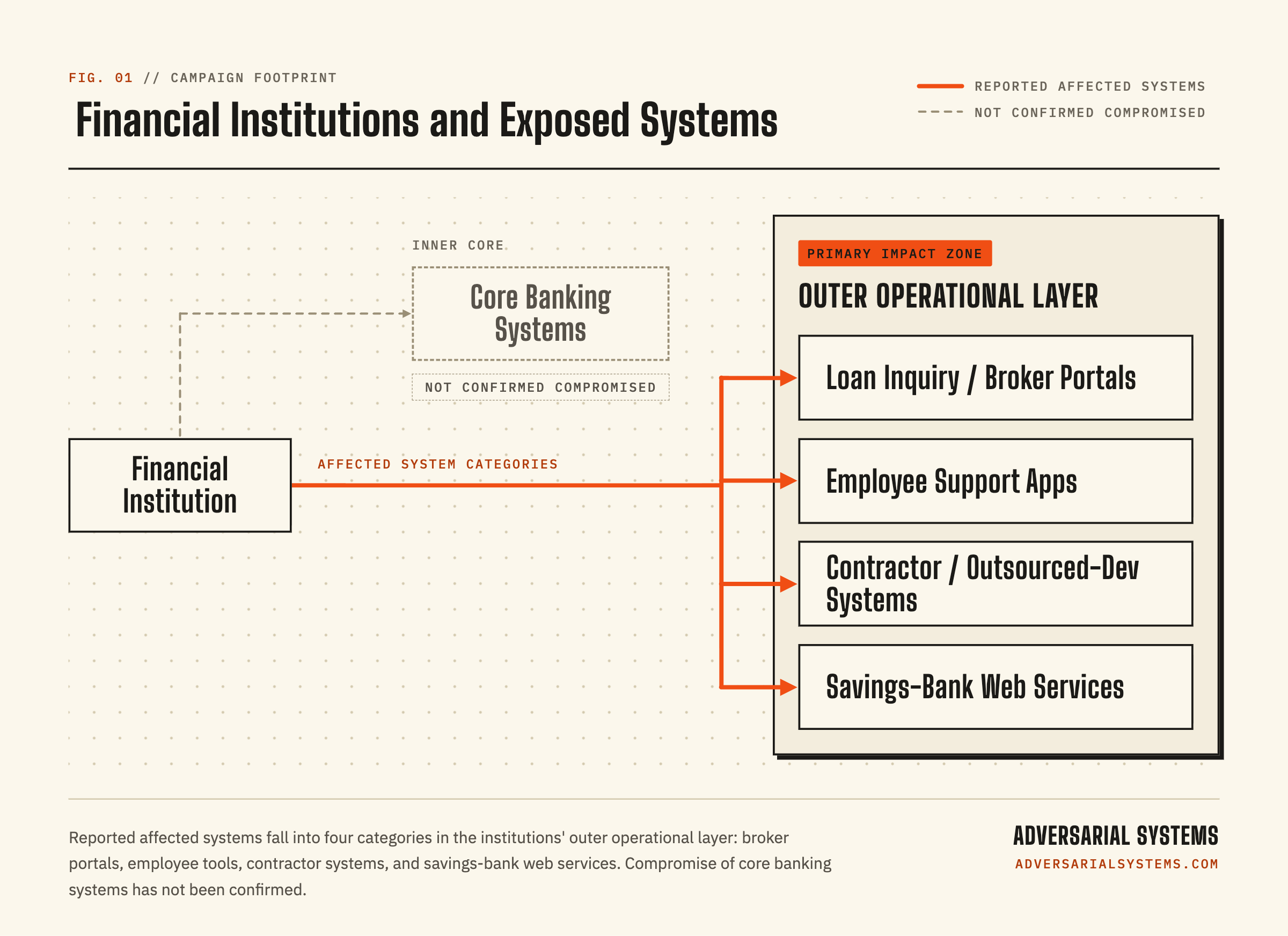
The important point is not that all seven institutions were compromised through an identical exploit. They were not, at least according to the available reporting. It’s that their affected systems occupied similar positions within the broader security architecture: business-critical applications surrounding the institution’s primary financial systems.
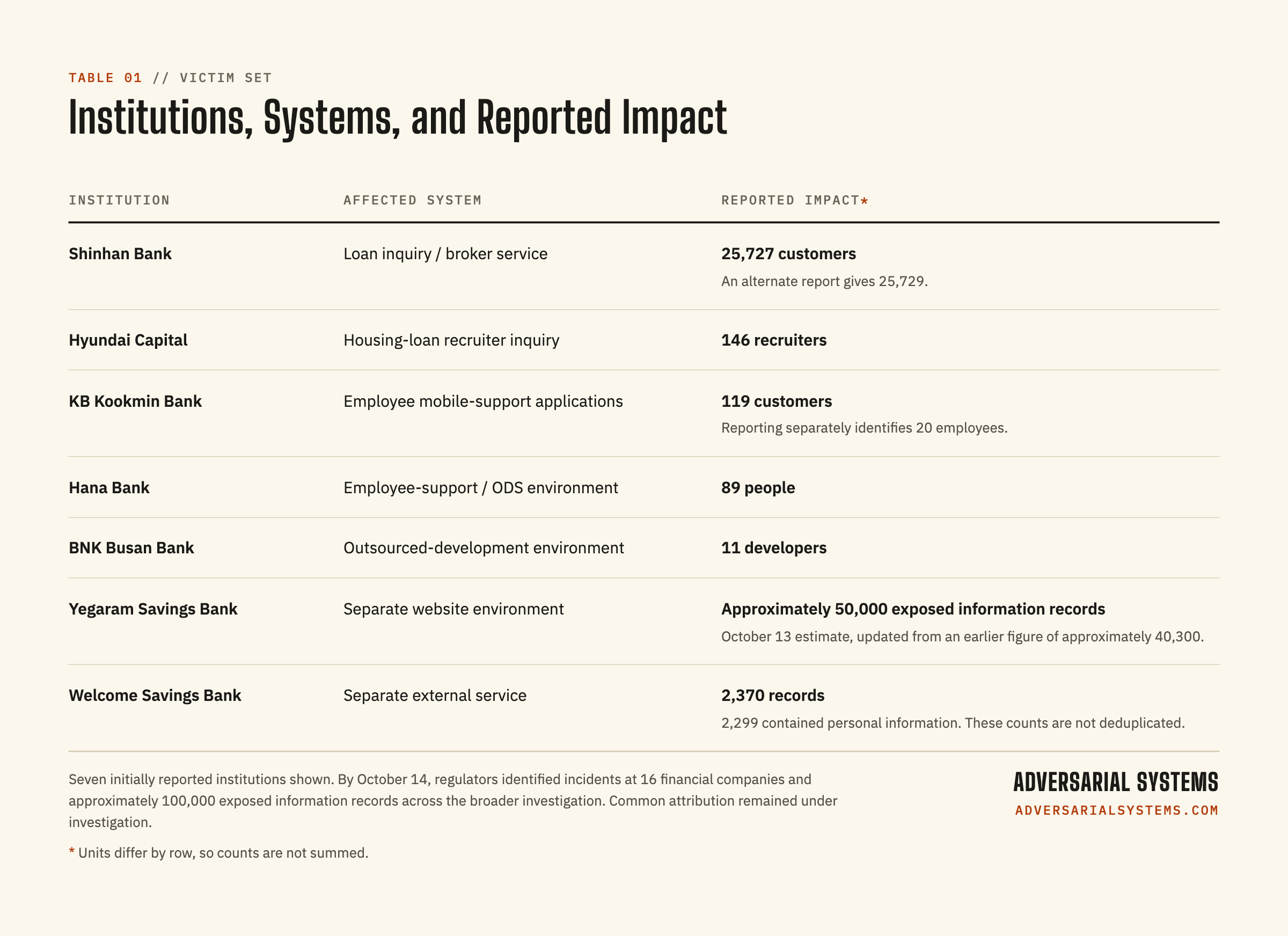
The seven institutions shown above were among the earliest reported victims. By October 14, South Korea's Financial Services Commission had confirmed data breaches at 16 financial companies, involving approximately 100,000 exposed information records. Investigators were still examining whether the incidents shared a common attacker and whether AI was used in each case.
For defenders, the distinction between core infrastructure and supporting applications matters because the value of exposed information is not necessarily proportional to the importance assigned to the underlying service. A relatively simple inquiry interface can contain sensitive customer information. An employee-support system may expose identifying details or internal business context. A contractor-facing application may hold records that were never intended to be publicly accessible.
The attacker only needs one sufficiently valuable weakness. Defenders are responsible for all of them.
What Investigators Actually Found
The initial reporting focused on data breaches across the Korean financial sector. The AI connection became more substantial as researchers identified infrastructure and artifacts associated with ARTEX and other AI-assisted tooling.
CrowdStrike reported finding two relevant server environments: a Hong Kong-based system assessed as the operator’s primary infrastructure, and a separate server hosting ARTEX. Additional exposed material included a Chinese-language CLAUDE.md instruction file, Claude Code session histories, ARTEX configuration files, and memory artifacts. Some of the recovered targeting information overlapped institutions named in the Korean financial-sector reporting.
The significance of those artifacts is that investigators were observing more than a reference to an AI tool. They had evidence of an operational environment configured to support offensive activity, along with records of AI-assisted interactions.
The reported model configuration also raises interesting questions about the underlying technology. CrowdStrike identified DeepSeek V4.1-Flash as the configured ARTEX backend, with GLM-5.3 and Grok 4.6 associated with additional Claude Code sessions. Claude Code, in this context, is an agent execution environment; its presence does not mean every underlying inference request used an Anthropic model.
The operator’s identity is less certain. CrowdStrike assessed the actor as likely Chinese-speaking and financially motivated, while subsequent reporting described a possible 26-year-old suspect whose identity has not been independently established. Recovered requests concerning the sale of stolen Korean data support a possible financial motive, but they do not establish a completed sale or prove that one individual performed every action.
The central distinction is between evidence of AI involvement and evidence of a fully autonomous compromise.
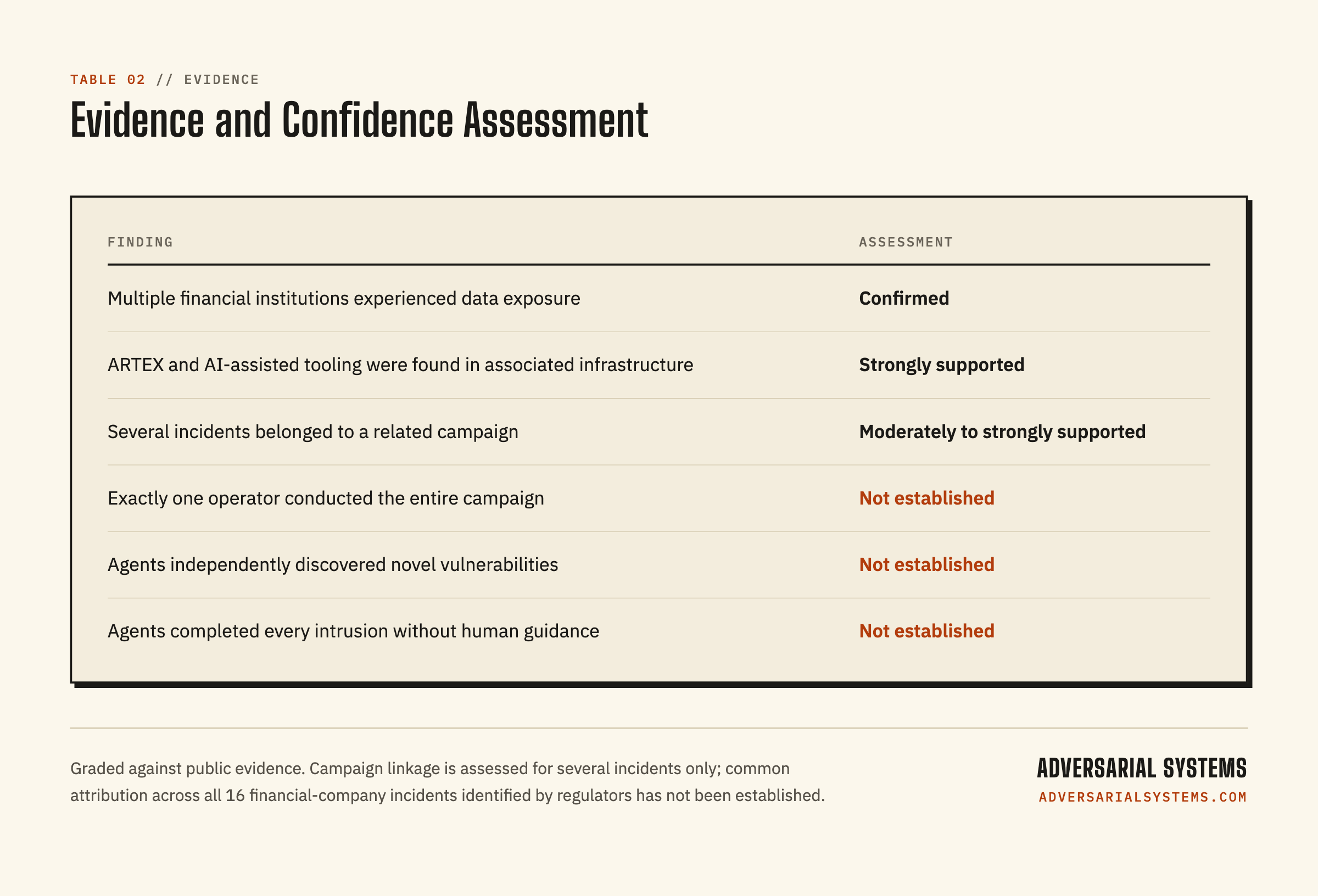
The available record supports the involvement of ARTEX and AI-assisted workflows in infrastructure associated with a multi-target intrusion operation. It does not establish which individual exploit requests came from which agent, whether the models independently discovered each vulnerability, or how much human effort was required.
This matters when evaluating offensive AI capability. A system that automatically executes hundreds of tests is not necessarily capable of independently identifying the most valuable targets, understanding their business context, or developing an exploitation strategy from a vague objective.
Those are different capabilities, and they should be evaluated separately.
To understand what ARTEX actually contributes, we need to examine the underlying software.
Inside ARTEX: The Planner, Workers, and Shared State
ARTEX is not a model trained exclusively to hack systems. It is a software framework that coordinates model-driven activity through a set of specialized roles and a persistent execution environment.
For this analysis, I examined ScopeWeaver, a publicly available English/Korean derivative of ARTEX based on an October 1 upstream revision. The code exposes much of the original framework’s architecture, although it should not be treated as a forensic copy of the exact version deployed during the Korean attacks. Some features in the current derivative were introduced after the incident began.
At a high level, the framework consists of a Go application, a Next.js interface, PostgreSQL-backed state management, and an underlying agent SDK called norma. When an operator submits a task, the system decomposes the objective into goals, establishes an exploration state, and starts a planning-and-execution process.
A serial planner examines the current state and creates prioritized intents, representing the next lines of investigation. A configurable pool of workers claims those intents and executes the corresponding technical work. In the analyzed revision, the default worker count is three, although that tells us nothing about how many workers the Korean attacker actually used.
The workers interact with models and general-purpose tools, including shell commands, file operations, browser functionality, and HTTP requests, depending on configuration. Instead of every worker operating within one enormous shared conversation, their discoveries are written into persistent state that other workers and the planner can inspect.
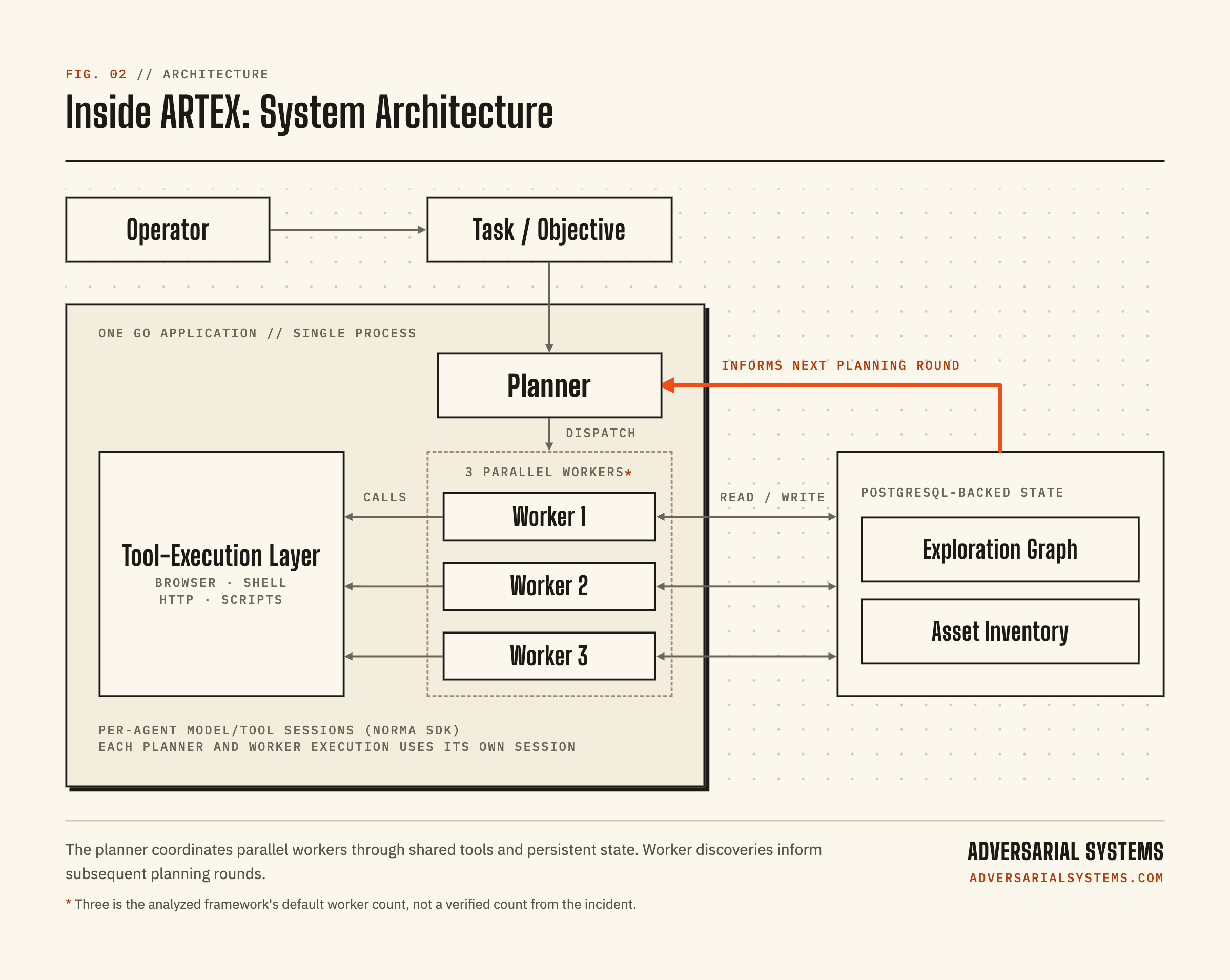
One of ARTEX’s more interesting architectural decisions is the separation between an asset inventory and an exploration graph.
The asset inventory represents information about the target environment: domains, applications, services, endpoints, and associated attributes. The exploration graph records the reasoning and execution structure of a particular task, including goals, attempted directions, discovered facts, and reported findings. Relationships connect observations to the intents that produced them, allowing subsequent planning rounds to inspect not only what was discovered, but why a particular direction was explored.
When a worker completes an intent or reports a finding, the planner can be notified and reconsider the next direction. New intents can depend on observations made during earlier work. The system also supports bounded worker sessions, stored transcripts, and recovery mechanisms that allow interrupted work to be resumed in certain circumstances.
This is useful for long-horizon offensive operations because the fundamental problem is not simply making more tool calls. It is coordinating exploration across an environment that may contain hundreds of applications, endpoints, and potential attack paths.
A powerful coding agent already has many of the primitives needed to discover meaningful vulnerabilities. But asking a single agent to investigate a large environment while maintaining every discovery, failed hypothesis, and pending task in conversational context creates considerable overhead. Orchestration can externalize some of that state management, allowing multiple workers to investigate different directions while a planner maintains the broader picture.
That does not make multi-agent orchestration automatically superior to a single strong agent. It adds scheduling, coordination, and failure-recovery complexity of its own. The benefit depends on how effectively the system divides work, shares useful observations, and prevents redundant exploration.
ARTEX is better understood as an event-driven workflow engine powered by multiple model sessions than as a collection of independent hackers. Its workers execute within one application process, and PostgreSQL provides the shared state.
The model still performs much of the difficult semantic work: deciding what to investigate, interpreting results, choosing tools, and judging whether an objective has been satisfied. The surrounding architecture makes those decisions easier to coordinate over a longer period.
From Attack Trajectories to Playbooks
The more interesting long-term implication of architectures like ARTEX is not simply that they can coordinate one assessment. It’s that autonomous offensive systems create an opportunity for experience to accumulate.
Offensive security has always been an experience-driven discipline. A principal- or staff-level researcher is usually more effective than a junior not because they have memorized every possible exploit, but because they’ve encountered more systems, recognize patterns sooner, understand why previous techniques failed, and know how to adapt earlier successes to unfamiliar environments.
A capable autonomous system could eventually develop some of that advantage through successful execution trajectories, reusable skills, and structured knowledge about the systems it has assessed.
The most valuable artifact from a successful exploitation attempt may not be the final script. It may be the trajectory that led to it: what the agent observed, which hypotheses it tested, which attempts failed, how the environment responded, and what evidence ultimately demonstrated impact.
Those trajectories could be distilled into reusable procedures or retained as references for future work. An agent encountering similar technologies could then retrieve relevant examples and adapt them to the deployment context in front of it.
Consider a vulnerability in a widely deployed component such as FFmpeg. Once a vulnerability is understood, applying that knowledge to another environment is often less about reinventing the underlying technique and more about determining how the component is deployed, whether the necessary preconditions exist, and what differs from a previously tested system.
Experienced human researchers already do this. They reuse techniques, scripts, playbooks, and institutional knowledge accumulated over years of work. Agents could make parts of that process considerably faster by retrieving successful trajectories and adapting prior methods to new environments.
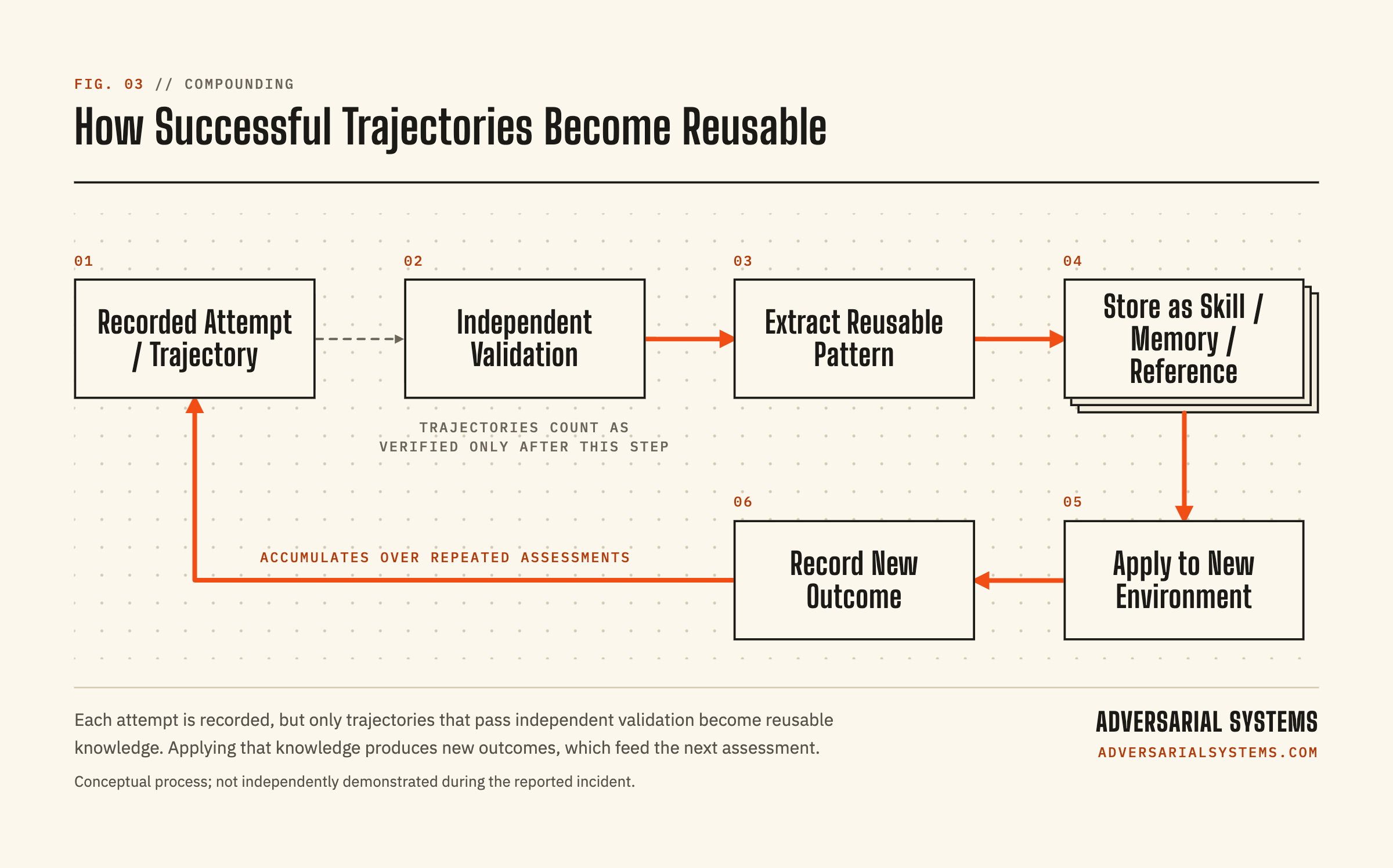
There is an important difference between this potential and ARTEX’s demonstrated implementation.
ARTEX provides persistent task state, recorded observations, and resumable execution histories. It does not, based on the public code analyzed here, demonstrate a complete system for automatically extracting and validating generalizable offensive skills across engagements.
That distinction is essential. The Korean incident does not establish that the attacker built a library of reusable exploits or accumulated successful trajectories across the institutions. The architecture illustrates how experience can be recorded and coordinated; more sophisticated cross-engagement learning remains a separate capability.
But the broader implication is compelling. A security company or offensive research organization that accumulates verified trajectories across many authorized assessments could eventually possess something more valuable than a collection of exploit scripts: a continuously expanding body of practical knowledge about how real systems fail.
The context layer may become one of the most important components of autonomous offensive security.
What Counts as Proof of Exploitation?
There is a significant caveat to the idea of accumulating successful offensive experience: the system has to know when it actually succeeded.
In the analyzed ARTEX implementation, a worker can submit a finding as confirmed through report_finding, even though the ordinary reporting path does not independently replay the exploit against the target. Evidence can be attached, but the model’s conclusion is not equivalent to an independent verification mechanism.
This distinction becomes important when considering the different objectives of a criminal operator and a legitimate security team.
For an attacker attempting to retrieve valuable data, the process may not need to be particularly elegant. Failed attempts, noisy exploration, and incomplete documentation may be acceptable if the desired outcome is achieved. The Korean reporting describes abnormal access and continued attempts after initial blocking at Shinhan, although that does not establish ARTEX’s individual traffic volume or operating behavior.
For a defensive security team, the standard is different. Vulnerabilities need to be reproducible, findings need to demonstrate impact, and engineers need enough reliable evidence to prioritize and remediate them. False positives create unnecessary work and make the entire system less trustworthy.
An independent validation mechanism can therefore improve the quality of autonomous offensive testing, even when the underlying model is already reasonably capable of discovering vulnerabilities.
It becomes even more important once successful trajectories are treated as reusable knowledge. If the system cannot distinguish demonstrated success from an agent’s mistaken interpretation, its accumulated experience risks becoming a library of false assumptions.
The distinction is not simply between an AI agent that can attempt attacks and one that can generate reports. It is between an agent that produces plausible conclusions and a system that can reliably establish what happened.
The Model Is Only Part of the System
Another interesting aspect of the Korean campaign is its reported model configuration. ARTEX was not necessarily relying on the most expensive frontier model for every decision. CrowdStrike identified DeepSeek V4.1-Flash in the recovered ARTEX configuration, alongside additional model references associated with Claude Code.
This reflects an increasingly important distinction in agent engineering: the intelligence of the underlying model matters, but it is not the sole determinant of system performance.
A strong frontier model may be better at complex reasoning, understanding unfamiliar application behavior, or developing strategies when straightforward approaches fail. But a well-engineered harness can extract meaningful capability from smaller, faster, and less expensive models, particularly when tasks are bounded and the system supplies useful tools, context, and feedback.
In my own work developing offensive security agents, I’ve seen how specialized harnesses can make capable, inexpensive open-weight models considerably more useful. Sometimes the better approach is to reserve stronger models for difficult reasoning and coordination while delegating routine, narrower tasks to faster models.
The same principle applies in ordinary software engineering. A powerful coding agent may coordinate a complex feature while smaller models handle more predictable subtasks. This can reduce latency and inference costs without sacrificing the stronger model’s role in guiding the overall work.
For offensive security, those tradeoffs become increasingly significant as agents run longer and execute more work. Provider restrictions and model refusals can also introduce operational friction, although there is no public evidence that the Korean attacker used a particular model-routing strategy to optimize around those constraints.
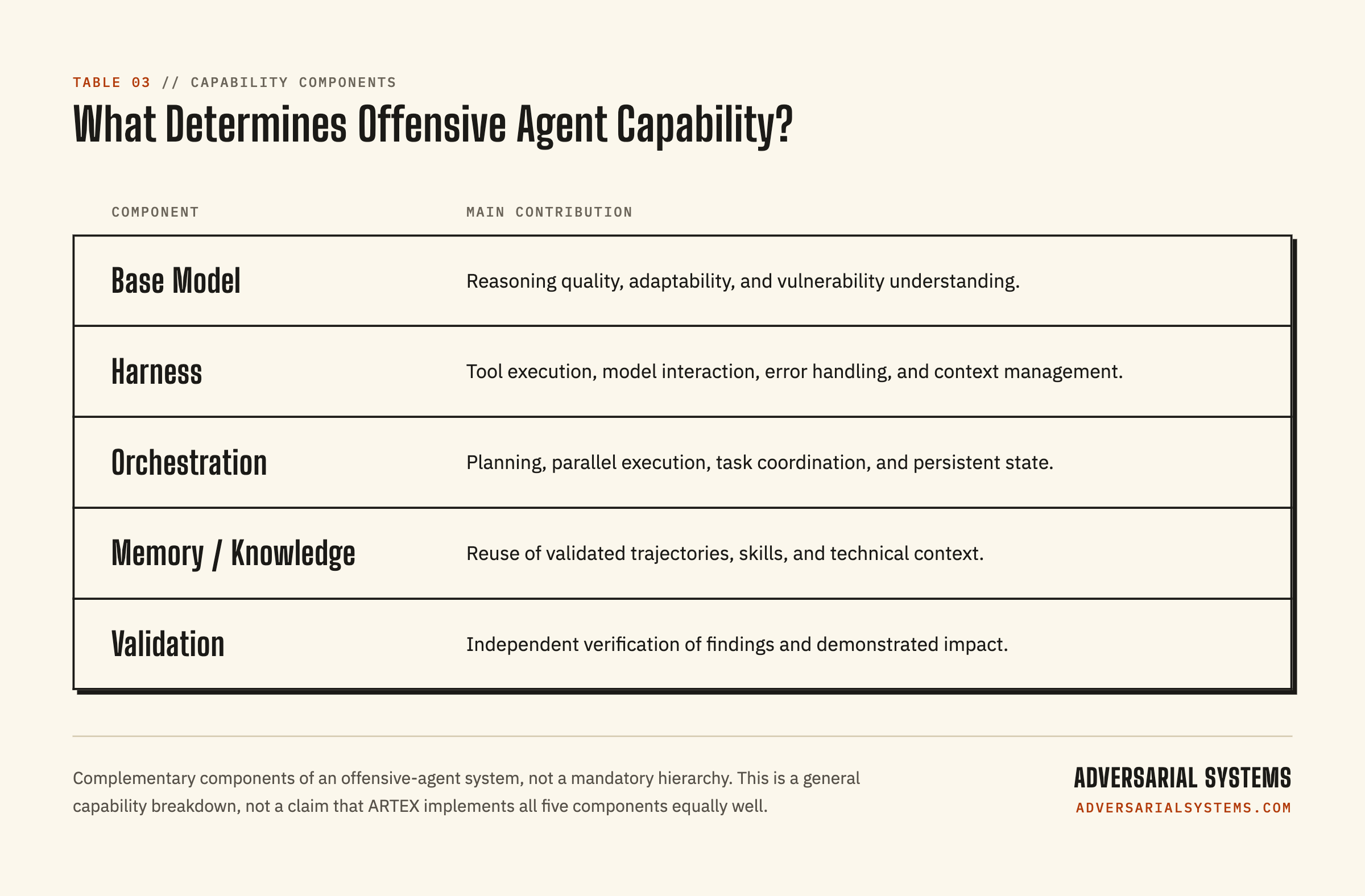
The fundamental point is that model intelligence, harness engineering, and orchestration contribute different things. The model reasons about the environment. The harness gives it practical means to act. Orchestration coordinates the work across time, tools, and execution contexts.
Understanding the resulting capability requires examining the complete system, not simply identifying which model appears in its configuration file.
The Economics of Scalable Offense
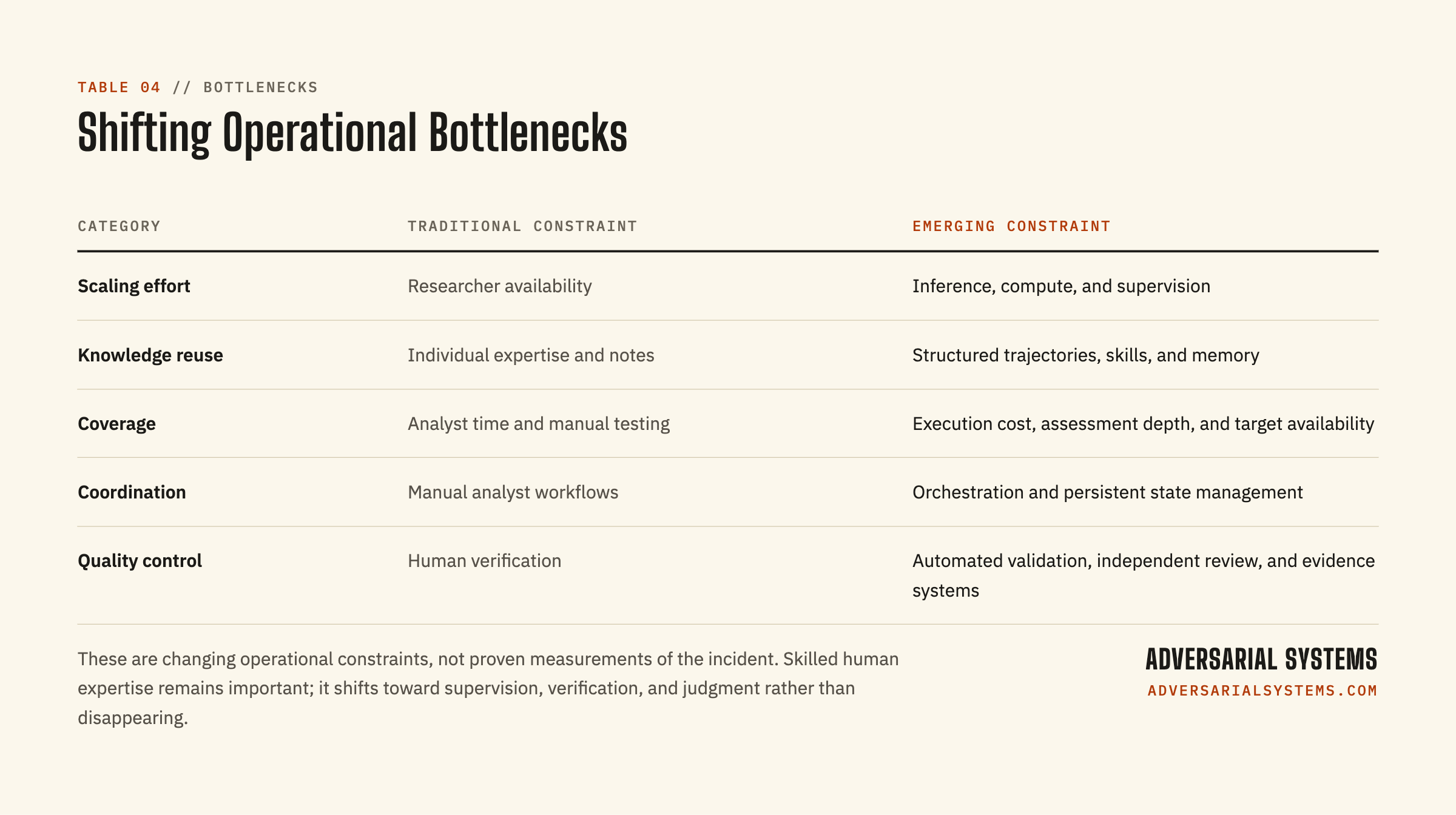
The larger implication of autonomous offensive systems is a change in the relationship between human expertise and the amount of technical work an operation can sustain.
Historically, expanding an offensive security operation required scaling some combination of personnel, infrastructure, tools, and coordination. More targets generally meant more researcher time. Reusing a successful approach still required someone to identify the next suitable environment, understand the technical differences, adapt the technique, and verify the result.
Agents can increasingly absorb portions of that work.
For traditional web applications and full-stack environments, autonomous systems are becoming capable of handling substantial amounts of reconnaissance, testing, and technical execution. A relatively small number of capable operators may be able to coordinate far more work than they could perform manually.
A separate investigation disclosed on October 26 provides another example of this shift. According to Yonhap, South Korean police identified a suspected operator and six accomplices linked to attacks against more than 90 organizations and the theft of approximately 8.2 million records. Investigators attributed attacks on 60 of those organizations to AI-assisted methods, with Seoul Economic Daily reporting that the operator had used an AI coding agent and an autonomous penetration-testing framework to compromise those 60 targets in just over 40 days. Police identified the framework as the same one implicated in the earlier financial-sector breaches, although no connection between the operators of the two campaigns has been established. The case further illustrates how a relatively small number of skilled individuals can scale offensive operations using publicly available AI tooling.
As that happens, the constraints shift. Human expertise remains important, but model inference, compute availability, task coordination, useful context, and the number of vulnerable targets become increasingly relevant to the economics of the operation.
This is not a universal transition across every technical domain. Industrial control systems, embedded devices, robotics, and complex financial environments still introduce specialized constraints that cannot be solved by simply pointing a general-purpose coding agent at a target.
Even in conventional applications, some of the most valuable human work occurs before an agent executes its first technical action. Choosing the target, understanding the business, identifying valuable assets, and supplying deployment context can substantially reduce the search space.
An agent pointed blindly at an unfamiliar application must infer much of that information itself. One supplied with a well-defined objective, relevant architectural details, and a knowledge base describing the business can often execute much more effectively.
This changes how we should think about human involvement in autonomous cyber operations. The operator’s contribution may increasingly be concentrated in defining objectives and supplying context rather than manually performing every step.
It also explains why the most capable users of offensive agents may remain experienced security researchers. Their expertise is not simply replaced by the system. It can be encoded into its instructions, tools, skills, and accumulated knowledge, expanding the amount of work that expertise can influence.
The South Korean campaign does not provide enough information to calculate the attacker’s actual inference spending, human labor, or productivity gains. But the underlying technology illustrates why those economics are becoming more important.
The cost of an additional attempt may increasingly be measured in model calls and execution time rather than additional hours from a human researcher.
Who Finds the Vulnerabilities First?
The response to this campaign should not be to panic about autonomous agents. It should be to recognize that offensive workflows are becoming easier to reproduce and operate at scale.
If attackers can systematically investigate externally reachable applications using automated offensive systems, defenders need to adopt comparable capabilities to discover and remediate weaknesses first.
The Korean incidents offer a particularly important lesson for financial institutions and other large enterprises. Protecting the core infrastructure is not enough when valuable information remains accessible through employee portals, external inquiry systems, partner integrations, and other supporting applications.
The appropriate response is to make adversarial testing a continuous part of security operations. Organizations should be discovering their exposed attack surfaces, testing real business workflows, validating vulnerabilities, and feeding the results directly into remediation and retesting.
This is the problem we’re working on at Pensar, where I lead R&D developing autonomous offensive security agents for testing real systems. The objective is to make the process of finding, validating, patching, and retesting vulnerabilities practical to run continuously, rather than relying exclusively on occasional point-in-time assessments.
The organizations that adapt most effectively won’t necessarily be those deploying the largest number of AI security products. They’ll be the ones that shorten the time between a vulnerability becoming discoverable and that vulnerability being fixed.
The South Korean campaign does not prove that a lone individual can autonomously compromise an entire financial sector. But it shows that publicly available offensive-agent software is already appearing in infrastructure associated with real intrusion campaigns, and that familiar weaknesses in peripheral applications remain sufficient to cause meaningful damage.
For decades, the scale of an offensive operation was constrained by the number of skilled people available to carry it out. Autonomous agents are beginning to break that relationship. The same expertise can now be applied across more targets, more frequently, without proportionally increasing the number of operators.
The next era of cyber offense may not be defined by the sophistication of any single exploit, but by how many ordinary weaknesses a single operator can afford to find.